

Passing the Torch: Building the Next Generation of Talent in Nuclear Energy
Written by Douglas Gray, Chief Administrative Officer at Nucleon Energy
North America is preparing to build nuclear infrastructure at a scale it has not attempted in decades.
New large reactors and Small Modular Reactors (SMRs) are advancing, existing facilities are being refurbished or having their operating lives extended, and governments across the globe and especially here in North America are putting renewed emphasis on domestic nuclear supply chains. But as attention shifts from technology to deployment, another practical question is becoming harder to ignore: who will build, operate and support the next generation of nuclear infrastructure?
The challenge is not that North America has to create a nuclear workforce from scratch. Canada and the United States already have experienced engineers, operators, tradespeople, manufacturers and nuclear professionals supporting established industries.
The challenge is one of timing. A significant share of that experienced workforce is approaching retirement at the same time the industry needs to grow.
Natural Resources Canada estimates that approximately 30% of Canada’s nuclear workforce will retire within the next decade. Globally, roughly 1.1 million new personnel could be needed by 2050 to support projected nuclear growth and replace retiring workers.
Meeting that demand will require more than recruiting the next generation of nuclear engineers. It will mean transferring decades of institutional knowledge, creating pathways for experienced workers from adjacent industries, expanding skilled trades and technical training, and building the workforce alongside the projects it will eventually support.
Nuclear Is Building Again, but the Workforce Has Changed
In a recent article, Nucleon Energy’s Chief Development Officer, Ryan Tourigny, described an idea that has emerged within the Nucleon team: “first-in-a-while.”
Unlike “first-of-a-kind,” which typically describes a new technology being built for the first time, first-in-a-while describes established industrial capabilities that have not been exercised at the same scale or frequency for many years.
Tourigny uses natural uranium conversion as an example. The underlying science is well understood, but after decades of limited new development and consolidation, some of the industrial experience required to turn that science into secure, scalable supply has become more concentrated.
The same concept can be applied more broadly to the nuclear workforce. North America retains deep nuclear expertise, but the industry now needs to preserve and expand that expertise as development grows.
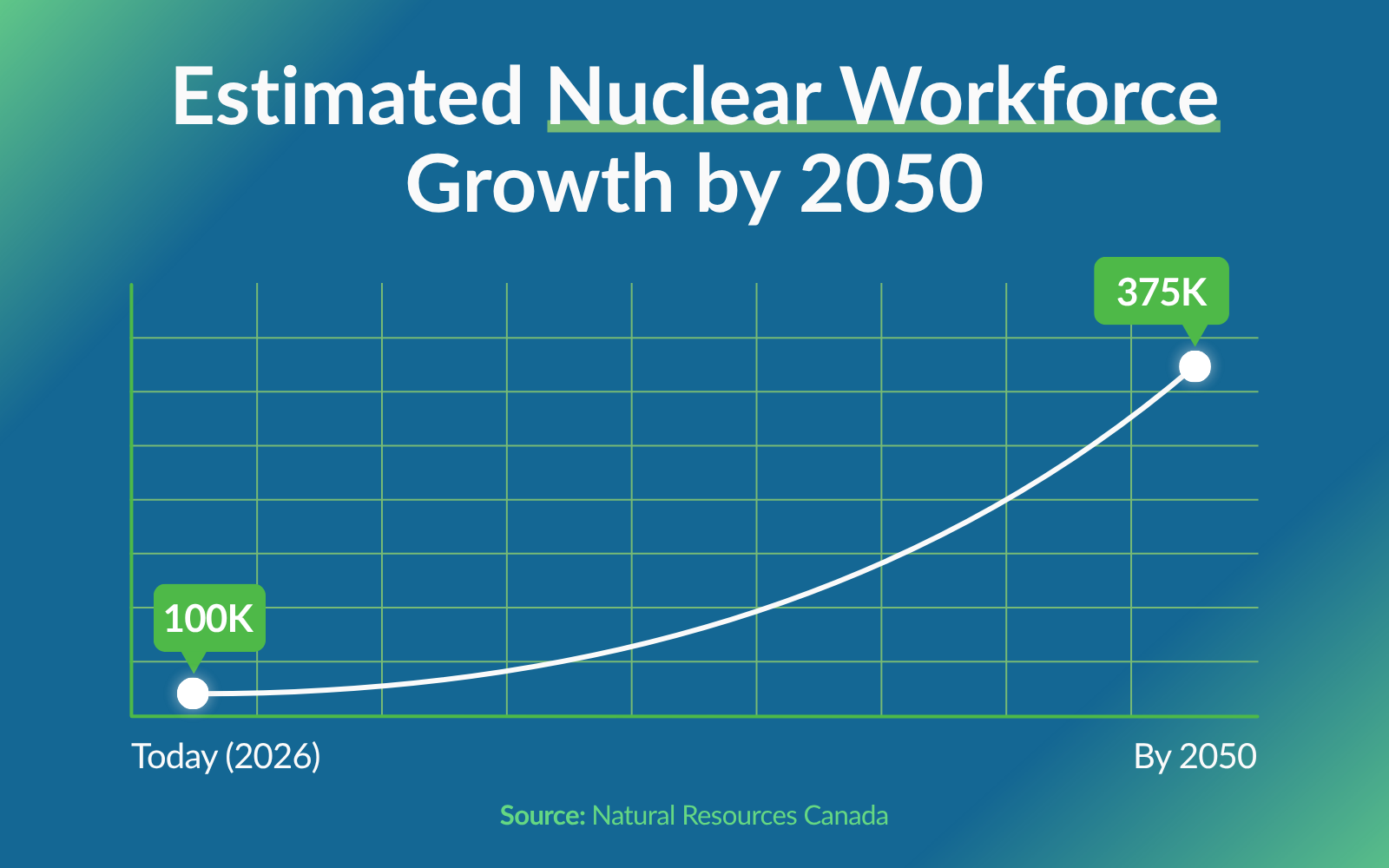
In the United States, the Department of Energy (DOE) estimates that the nuclear workforce could grow from 100,000 to approximately 375,000 workers by 2050 with the deployment and commercialization of advanced reactors.
The question, then, is not simply how to replace retiring workers. It is how to transfer what they know while creating a substantially larger workforce around them.
 Transferring Knowledge to the Next Generation
Nuclear facilities are designed, built and operated within highly regulated environments where safety culture, quality assurance and institutional knowledge matter. Replacing that experience isn’t as simple as filling a vacant role.
An engineer or operator who has spent decades working within a nuclear facility carries experience that does not necessarily live in a manual or training module. The same is true for project managers, maintenance personnel, skilled trades and specialists who have learned how complex nuclear projects and facilities work in practice.
The DOE’s Paducah Site in Kentucky provides a useful example. As newer workers prepare for deactivation activities at the former uranium enrichment site, longtime employees are transferring knowledge from the site’s previous operations. According to DOE, the mentors involved bring more than 300 years of combined experience.
Mentorship, apprenticeships and hands-on training create opportunities to transfer not only technical knowledge, but also the judgement and safety culture developed through years of practical experience.
The Next Nuclear Workforce Is Bigger Than Nuclear Engineers
When people think about careers in nuclear energy, nuclear engineers may be the first role that comes to mind. However, the workforce required to deliver nuclear infrastructure is much broader.
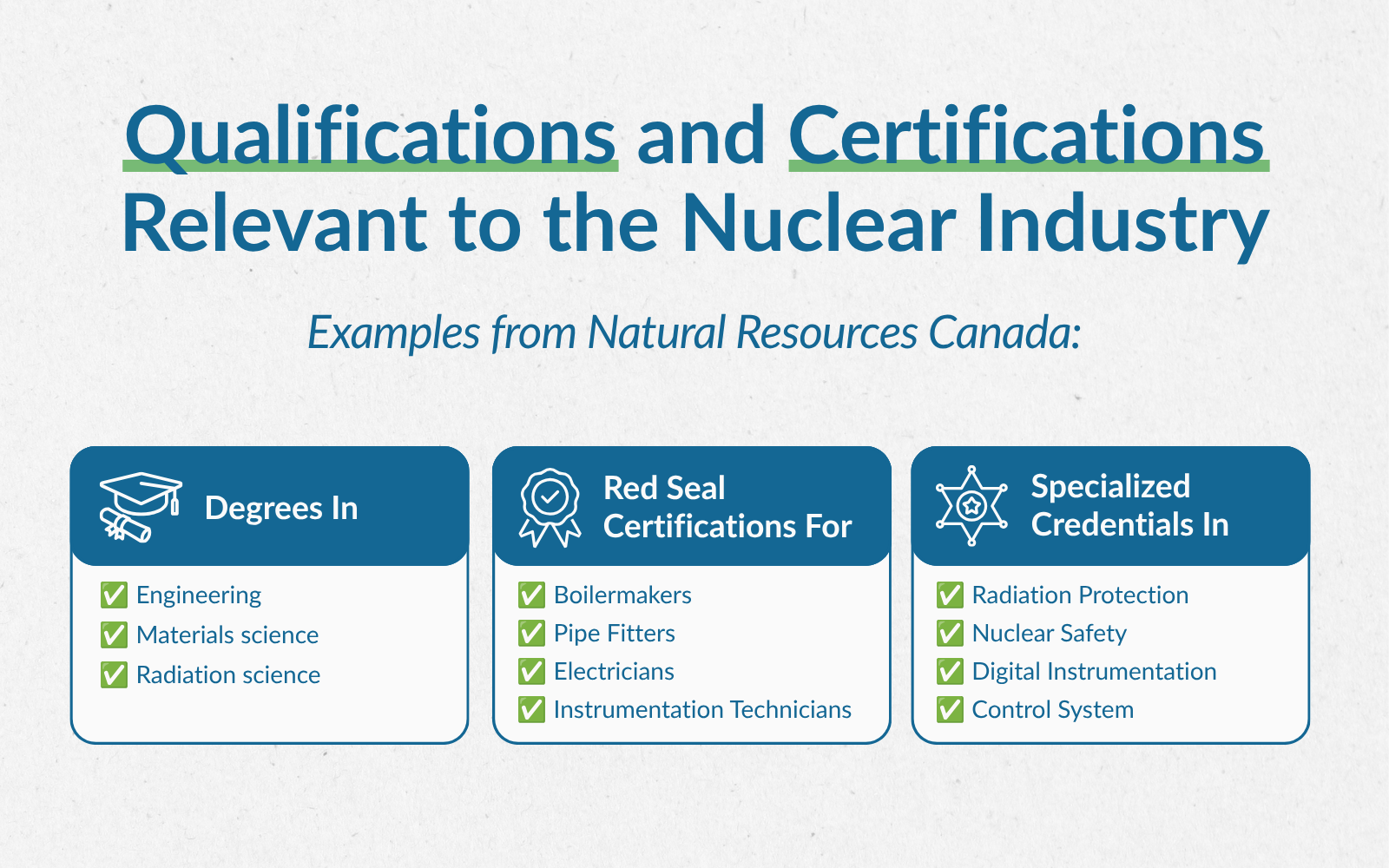
Projects need engineers and reactor operators, but they also depend on electricians, welders, pipefitters, machinists, construction workers, project managers, radiation protection specialists, quality professionals, maintenance teams and manufacturers.
This distinction becomes particularly important as the industry moves into construction. DOE analysis identifies construction and manufacturing as major areas of future workforce demand, with skilled trades such as welders, electricians, metalworkers and fabricators among the most constrained occupations.
Hiring pressure is already visible. More than 80% of U.S. employers across nuclear construction, manufacturing, professional services and utilities reported at least some difficulty finding qualified workers last year.
Expanding the nuclear workforce therefore cannot depend on one educational pathway. Four-year engineering programs will remain important, but so will colleges, technical schools, apprenticeships, industry training and opportunities for experienced workers to enter nuclear from other sectors.
Part of the Next Nuclear Workforce Is Already Working Somewhere Else
North America has a significant pool of people working in complex industrial environments such as oil and gas, refining, conventional power generation, mining and manufacturing. Many have experience in areas nuclear projects also require, including engineering, fabrication, instrumentation, project execution, maintenance, quality assurance and industrial safety.
For regions with established energy and industrial workforces, including Western Canada and parts of the United States, that creates an important opportunity.
But transferable experience does not mean workers can simply move from one industry to another without additional preparation. Nuclear has specific regulatory, safety, quality and technical requirements. The opportunity is to recognize where existing capabilities transfer and then build the nuclear-specific knowledge around them.
Ontario Tech University’s Nuclear Career Accelerator offers one example. The 11-week program is designed for engineers and technical professionals from industries including oil and gas and manufacturing who want to apply their existing experience within the nuclear sector.
Approaches like this can help expand the available talent pool without treating every nuclear career as though it needs to begin with a nuclear-specific university degree.
 Universities and Colleges Are Rebuilding the Talent Pipeline
Educational institutions across North America are expanding pathways into the industry.
In Canada, McMaster University announced a new undergraduate Nuclear Engineering degree in 2026, with the first cohort able to enter the program in September 2027. Saskatchewan Polytechnic became the first polytechnic institution to partner with the University Network of Excellence in Nuclear Engineering (UNENE) in 2025, with the partnership exploring education, training and upskilling opportunities to address workforce needs.
In the United States, the Nuclear Reactor Safety Training and Workforce Development Program received $100 million to support university-led partnerships involving universities, community colleges, technical colleges, industry and national laboratories. In April 2026, DOE awarded $49.7 million to 10 university-led projects focused on nuclear safety training and workforce development.
These initiatives point toward a broader workforce pipeline that includes universities, polytechnics, community colleges, trades programs, industry partnerships and mid-career training.
Building the Workforce Has to Start Before Construction
In an earlier Nucleon Energy article, we explored how the nuclear conversation is shifting from technology to deployment.
As nuclear projects move closer to execution, workforce capacity is one of the practical requirements that comes into sharper focus.
A reactor project cannot wait until construction begins to determine whether enough qualified tradespeople will be available. A new fuel-cycle facility cannot wait until commissioning to start transferring specialized operational knowledge. And an industry anticipating significant retirement cannot wait until experienced workers leave to begin capturing what they know.
Workforce development needs to happen alongside project development. That means identifying future workforce requirements early, creating partnerships between industry and educational institutions, supporting apprenticeships and experiential learning, building pathways for workers from adjacent sectors, and deliberately pairing experienced professionals with the people who will eventually take their place.
Canada’s 2026 Nuclear Energy Strategy reflects the scale of that task. The strategy includes an objective to double Canada’s nuclear workforce by 2050, alongside expanding education, training and opportunities for workers to transition from other sectors.
North America does not need to relearn nuclear energy from the beginning. Decades of expertise already exist across utilities, laboratories, universities, regulators, manufacturers, the skilled trades and the broader supply chain.
The task now is to make sure that knowledge moves forward.
If the industry can transfer what one generation has learned, create more pathways into nuclear energy careers and bring experienced industrial talent into the sector with the appropriate nuclear-specific training, today’s generational transition can become an opportunity to build a deeper and more resilient workforce.
The next era of nuclear will depend not only on new technologies and infrastructure, but on the people with the skills and experience to deliver them.
Related Reading: