
How Nuclear Small Modular Reactors (SMRs) Are Designed And Regulated To Address Risk
When people hear that a nuclear facility might be coming to their community, safety is usually the first question that comes to mind.
That’s because nuclear energy has a history that has given people legitimate reasons to ask hard questions, and those questions deserve honest answers.
But the conversation about nuclear safety has changed significantly in recent decades, and in ways that don’t always make it into headlines. The technology has evolved, the regulatory frameworks have deepened, and a newer class of reactor—the Small Modular Reactor (SMR)—has been designed from the ground up with a different philosophy toward risk than the nuclear plants that came before it.
This article aims to give you a clear, honest picture of how risk is addressed in modern nuclear SMR design and regulation—from the physics built into the reactor itself, to the independent oversight that continues across its entire operating life.
Understanding how safety works is the foundation for meaningful conversation about whether a project like this belongs in your community.
A Brief History of Nuclear Safety (And Why It Matters Today)
To understand where nuclear safety stands today, it helps to understand where it came from.
The first commercial nuclear power plants were built in the 1950s and 60s, during an era when the priority was proving that nuclear energy could work at scale. These were pioneering facilities, and like most pioneering technology, they were built with the knowledge and tools available at the time. Safety systems existed, but they were largely active systems—meaning they depended on mechanical components, electrical systems, and human intervention to function correctly under pressure.
Three events, across three decades, tested those systems in ways their designers hadn’t fully anticipated.
In 1979, a combination of equipment failure and operator error at Three Mile Island in Pennsylvania led to a partial meltdown—the most serious nuclear accident in US history. No direct deaths were attributed to radiation, but the event exposed real gaps in reactor design, emergency preparedness, and regulatory oversight, and fundamentally changed public trust in nuclear energy.
Seven years later, in 1986, the Chernobyl disaster in Soviet Ukraine became the defining nuclear event of the 20th century. A flawed reactor design, combined with a fatally mismanaged safety test, caused an explosion and fire that released radioactive material across much of Europe. The human and environmental toll was severe and long-lasting. Chernobyl didn’t just raise questions about nuclear safety. It demanded a reckoning with how reactors were designed, operated, and governed.
Then in 2011, the Fukushima Daiichi accident in Japan showed that even a well-regulated, modern facility could be overwhelmed by circumstances outside its design assumptions. A magnitude 9.0 earthquake, followed by a tsunami that exceeded the plant’s protective barriers, knocked out the cooling systems that the reactor depended on to stay stable. Three reactors melted down. No direct radiation fatalities occurred, but the evacuation of over 150,000 residents caused significant and lasting harm.
Each of these events was different in cause, context, and consequence. But together, they drove a fundamental shift in how the global nuclear industry approached the question of safety—not as something to be managed after the fact, but as something to be engineered out of the system from the start.
That shift is the foundation of how modern SMRs are designed today.
How SMR Design Addresses Risk Differently
The accidents described above share a common thread: in each case, the reactor’s safety depended on something external working correctly—a pump, a backup generator, a protective barrier, a human decision made under pressure. When those external factors failed, the consequences followed.
Modern SMR design starts from a different premise entirely. Rather than building a reactor and then layering safety systems on top of it, SMRs are engineered so that safe behaviour is built into the physics of the reactor itself. This approach is known as passive safety, and it represents one of the most significant shifts in nuclear design thinking in the technology’s history.
What Passive Safety Actually Means
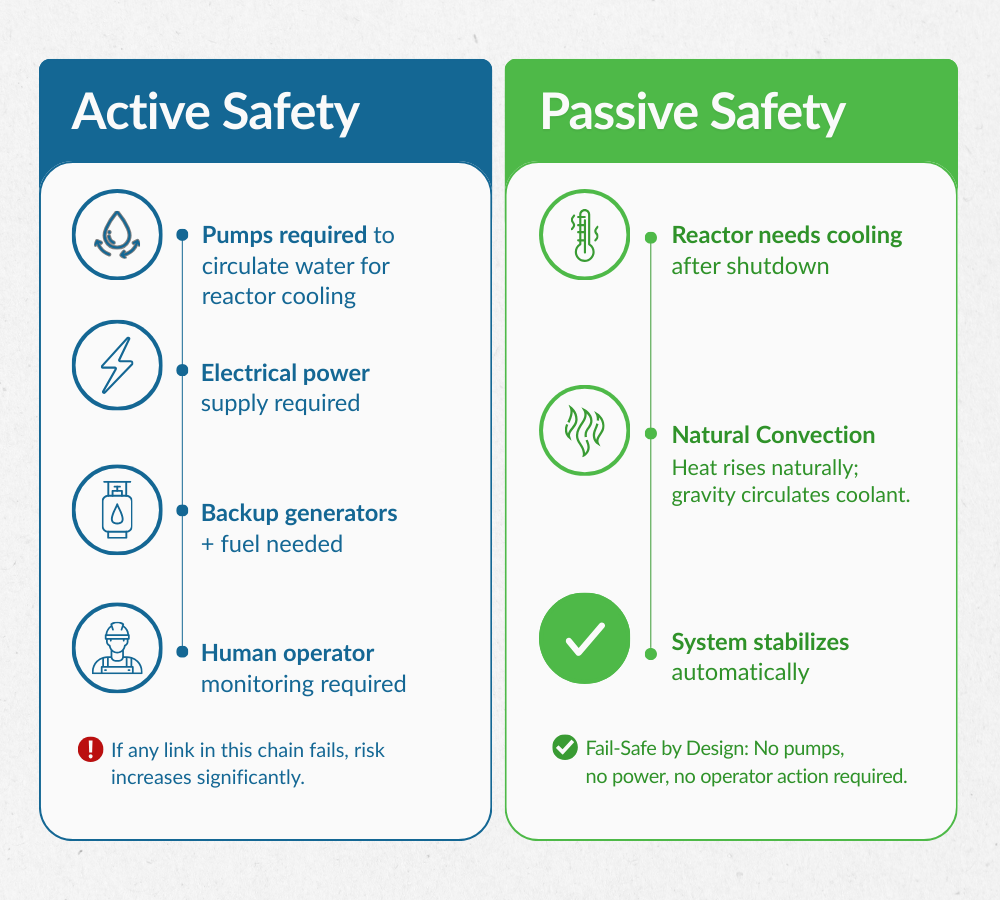
In a traditional large reactor, keeping the nuclear fuel cool after the reactor shuts down requires active systems—pumps circulating coolant, power supplies keeping those pumps running, and operators monitoring and responding in real time. If any part of that chain breaks down, the risk of overheating increases.
Passive safety systems eliminate that dependency. Instead of relying on pumps and power, they use fundamental forces—gravity, natural convection, and the basic physical properties of the materials inside the reactor—to keep the fuel stable without any external input. Think of it less like a machine that needs to be actively controlled, and more like a system that naturally returns to a safe state when left alone.
In practical terms, this means that if an SMR loses power, loses its operators, or experiences an unexpected event, the reactor is designed to cool itself down without intervention.
Smaller Scale, Smaller Consequence
The modular, compact nature of SMRs also changes the risk profile in a more straightforward way: there is simply less fuel in the core at any given time compared to a large conventional reactor. This means that even in a worst-case scenario, the potential scale of any release of heat or material is significantly smaller, and more manageable, than what older large-scale facilities would have presented. This is a deliberate design choice that directly reduces the upper boundary of what could go wrong.
Learning Built Into the Design
It’s also worth noting that SMRs aren’t designed in isolation. They are the product of decades of accumulated operating experience, incident analysis, and evolving international safety standards. The lessons of Three Mile Island, Chernobyl, and Fukushima are embedded in the engineering requirements, design reviews, and regulatory standards that every modern SMR must meet before it is approved to operate.
In this sense, the history outlined in the previous section isn’t separate from modern SMR design. It is part of what shaped it.
How SMRs Are Regulated
Good design is only part of the safety equation. The other part is independent oversight that ensures what is built, and how it operates, is verified by someone other than the people who built it.
In both Canada and the United States, nuclear facilities are among the most heavily regulated infrastructure in existence. The frameworks governing them have been built and refined over decades, and they require developers to meet rigorous technical, environmental, and safety standards before a single component goes in the ground, and continuously throughout the life of the facility.
Canada: The Canadian Nuclear Safety Commission
In Canada, nuclear regulation falls under the Canadian Nuclear Safety Commission, or CNSC. The CNSC is an independent federal agency—meaning it operates at arm’s length from both government and industry—whose mandate is to regulate the use of nuclear energy and materials to protect the health, safety, and security of Canadians and the environment.
For an SMR developer, earning the right to build and operate a facility is not a single approval. It is a staged process that unfolds over many years and includes multiple independent technical reviews. The CNSC’s licensing process moves through distinct phases, including site preparation, construction, operation, and eventually decommissioning, with separate regulatory review and approval required at each stage. A project cannot advance from one phase to the next without satisfying the requirements of the one before it.
The CNSC also offers a pre-licensing Vendor Design Review process, which allows reactor designers to have their technology assessed against Canadian regulatory requirements before a specific project is proposed. This step, while voluntary, is an important signal of regulatory readiness—and several SMR developers, including those working with technology relevant to the Canadian market, have already engaged in this process.
The United States: The Nuclear Regulatory Commission
In the United States, that independent oversight role belongs to the Nuclear Regulatory Commission, or NRC. Like the CNSC, the NRC operates independently of the federal government’s energy policy interests, with a specific mandate focused on safety and environmental protection.
The NRC’s licensing process for new nuclear facilities is similarly staged and rigorous. Developers must demonstrate, through extensive documentation and independent technical review, that their design is safe, that the proposed site is suitable, and that the applicant is qualified to build and operate the facility. Public participation is built into the process, including opportunities for community members and interveners to raise concerns and have them formally considered.
In recent years, the NRC has also developed updated regulatory frameworks specifically designed to accommodate advanced reactor designs, including SMRs. This reflects a recognition that the regulatory system itself must evolve alongside the technology it oversees while maintaining the same standard of independent scrutiny.
What SMR Regulation Requires
It’s worth being specific about what these processes demand in practice. Before an SMR can be licensed to operate, the developer must demonstrate:
- That the reactor design meets established safety standards, including the ability to shut down safely under a range of accident scenarios
- That the proposed site has been assessed for environmental, seismic, and community impact
- That emergency planning is in place and has been reviewed with local authorities
- That the applicant has the financial, technical, and organizational capacity to build and operate the facility responsibly
These are not self-reported assurances. They are independently verified by technical staff at the CNSC or NRC, through a process that is documented, transparent, and open to public scrutiny.
Regulation doesn’t guarantee that nothing will ever go wrong. What it does is ensure that every reasonable step has been taken to understand and address risk before a facility ever comes online, and that an independent authority, not the developer, makes that determination.
Safety Doesn’t Stop at Startup
Regulatory approval to build and operate a nuclear facility is not the finish line, but rather the beginning of an ongoing relationship between the developer, the regulator, and the community. Once an SMR is operating, the oversight framework that governed its design and construction continues in full force, with regular inspections, mandatory reporting, and independent monitoring throughout the facility’s operating life.
This includes continuous environmental monitoring around the site, routine safety performance reviews, and requirements to report any abnormal event—no matter how minor—to the regulator. Neither the CNSC nor the NRC waits for problems to surface. Both agencies conduct scheduled and unannounced inspections, and both maintain the authority to order operational changes or shutdowns if safety standards are not being met.
It’s also worth noting that while SMR development is still in its early stages across the globe, the technology is picking up speed. Russia’s Akademik Lomonosov, the world’s first floating nuclear power plant, began commercial operation in 2020, and China connected its pebble-bed modular reactor to the grid in 2021—both operating under active regulatory oversight.
Looking further ahead, the same regulatory discipline extends to the end of a facility’s life. Decommissioning—the process of safely shutting down and dismantling a facility after its operating years—is planned and funded from the outset. Regulators require developers to demonstrate, before a licence is ever granted, that a credible and financially secured decommissioning plan exists.
What “Addressing Risk” Means
No energy source is without risk. Coal mines have accidents, gas pipelines fail, and wind turbines require workers at significant heights. The honest question isn’t whether nuclear energy carries risk, but how that risk compares, and how it is managed.
The data here is worth stating plainly. According to Our World in Data, nuclear energy results in 99.8% fewer deaths than coal and 97.6% fewer deaths than gas, even when the full toll of historic accidents like Chernobyl and Fukushima is factored in. Wind, solar, and nuclear are the safest energy sources by a significant margin, each responsible for fewer than 0.1 deaths per terawatt-hour of electricity produced, compared to roughly 25 deaths per terawatt-hour for coal. That data is sourced from peer-reviewed research and includes accidents, air pollution, and supply chain impacts.
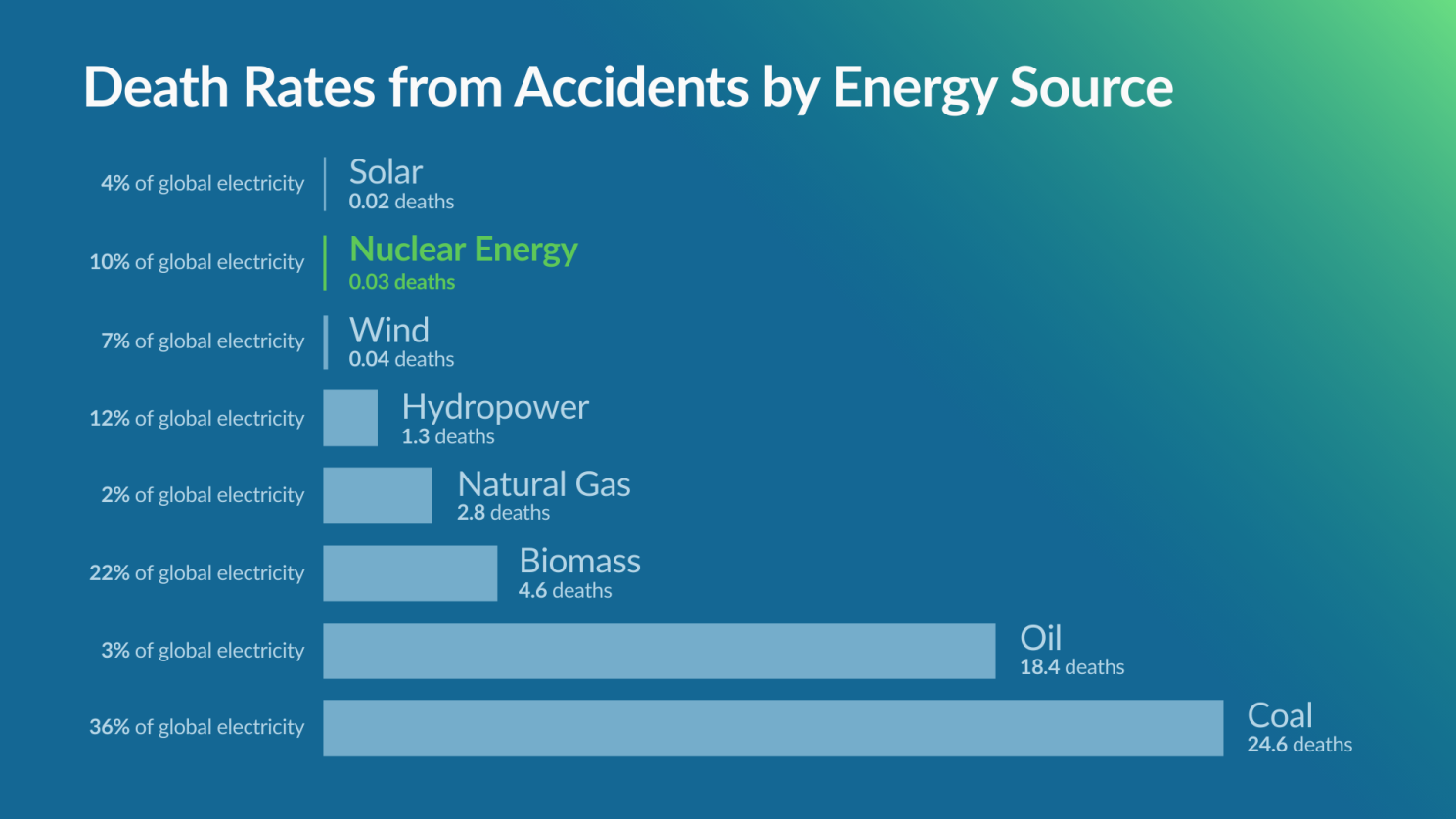
Data sourced from Our World In Data: https://ourworldindata.org/nuclear-energy
Understanding Before Alignment
The information presented in this article doesn’t mean concerns about nuclear energy are unfounded, but that they deserve to be weighed against the full picture. The goal of SMR design and regulation isn’t to eliminate all conceivable risk, because no technology can honestly make that promise. It is to identify risk clearly, design around it rigorously, regulate it independently, and monitor it continuously across the full life of the facility.
If you’d like to learn more about SMRs and how they are shaping our energy future, follow Nucleon Energy on LinkedIn.